Create your first route in minutes
Your dispatch panel, driver app, and proof of delivery — all in one place.
Start your 7-day free trialThis post is also available in 简体中文 and 繁体中文.
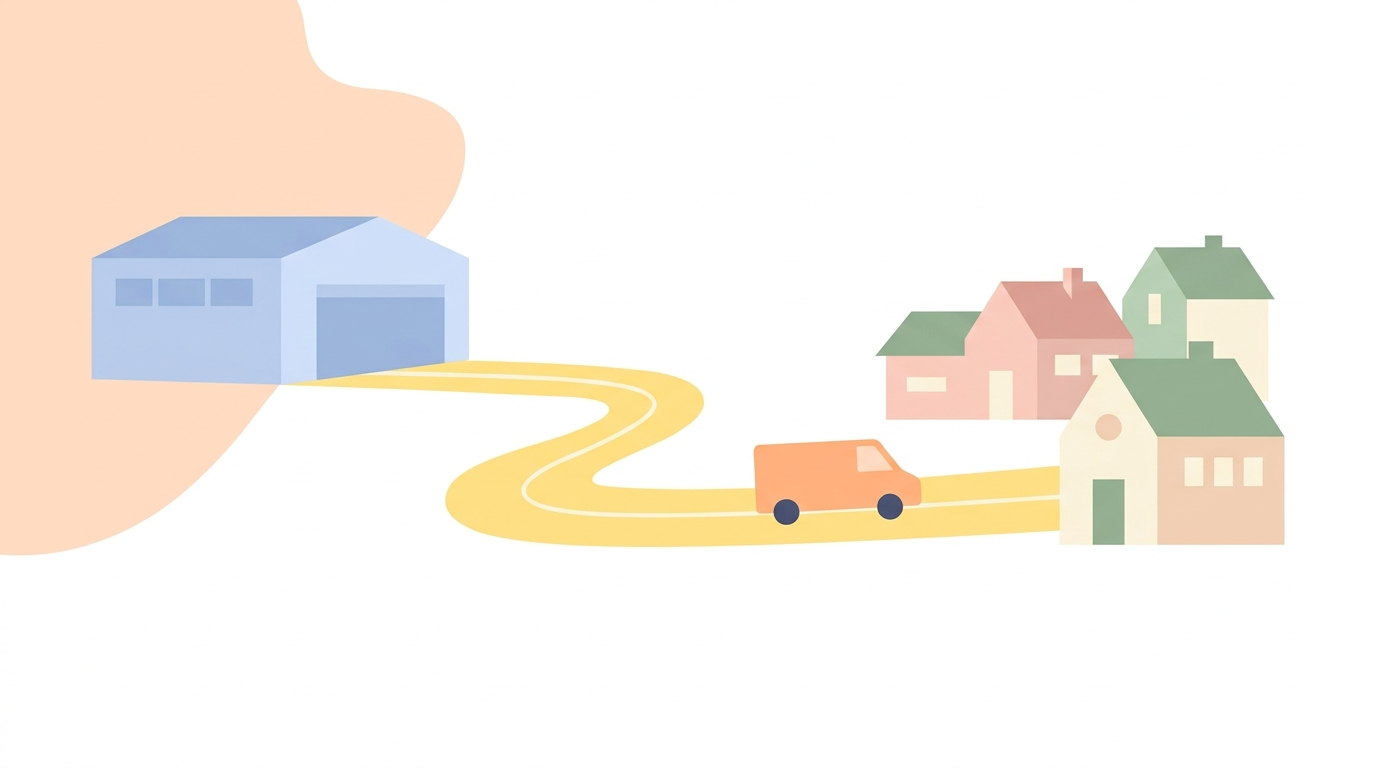
If you run a delivery operation -- whether it is parcels, food, flowers, or building materials -- the last mile is where your money goes. It is the most expensive, most complex, and most visible part of your entire supply chain. Get it right and customers come back. Get it wrong and they do not.
This guide breaks down what last mile delivery actually means, why it costs so much, and what you can do to bring those costs under control.
What Is Last Mile Delivery?
Last mile delivery refers to the final leg of a shipment's journey -- from the last distribution hub or warehouse to the customer's door. Despite the name, it rarely covers just one mile. It could be three kilometres in a dense city centre or forty kilometres out to a rural property.
The term "last mile" comes from telecommunications, where connecting the final stretch to individual homes was always the hardest part. The same principle applies to logistics. Moving a container from Shanghai to Sydney is relatively straightforward. Getting that individual package from a warehouse in western Sydney to a specific apartment in Surry Hills during a two-hour window -- that is where the complexity lives.
Last mile delivery includes activities like:
- Loading vehicles at the depot
- Navigating to each delivery address in sequence
- Managing failed delivery attempts and re-deliveries- Handling delivery windows and time-sensitive drops- Handling delivery windows and time-sensitive drops
Why Last Mile Delivery Matters
Here is the number that gets every logistics manager's attention: last mile delivery accounts for approximately 53% of the total cost of shipping a product. That is not a typo. More than half of your entire shipping spend happens in that final stretch.
Why is it so expensive? Because everything that was efficient about the earlier stages breaks down. A single truck carrying 500 parcels from a port to a warehouse is cheap per unit. But once those parcels split into 15 different vans heading to 500 different addresses across a metro area, costs multiply fast.
Consider what is involved:
- Labour: Drivers spend hours navigating, parking, walking to doors, waiting for customers, and handling exceptions
- Fuel: Stop-and-go driving in urban areas burns significantly more fuel per kilometre than highway transport
- Vehicle wear: Frequent stops, tight turns, and loading zone manoeuvres accelerate vehicle maintenance costs
- Failed deliveries: Every missed delivery costs you the original attempt plus the re-delivery -- effectively doubling the expense for that stop
For businesses operating on thin margins -- which is most delivery businesses -- last mile efficiency is not a nice-to-have. It is the difference between profit and loss.
The Key Challenges of Last Mile Delivery
Failed Deliveries
Industry data shows that roughly 8% of first-attempt deliveries fail. The customer is not home, the address is wrong, there is no safe place to leave the parcel, or access is restricted. Each failed delivery costs between $12 and $20 when you factor in the wasted time, fuel, and the subsequent re-delivery attempt.
For a fleet making 200 deliveries per day, that is 16 failed drops costing up to $320 daily -- over $80,000 per year in pure waste.
Traffic and Urban Congestion
Delivery vehicles spend a surprising amount of time stationary. In major cities, drivers can lose 30-60 minutes per shift sitting in traffic or circling for parking. That is not just wasted fuel -- it is wasted capacity. Every minute a driver spends stuck in traffic is a delivery they are not making.
The problem compounds during peak hours, which unfortunately overlap with the times many customers want their deliveries.
Customer Time Windows
Modern customers expect precision. "Sometime between 8am and 5pm" is no longer acceptable. Businesses now promise two-hour or even one-hour delivery windows. Meeting these windows consistently requires sophisticated planning -- you cannot just send drivers out with a list of addresses and hope for the best.
Miss a window and you face a choice: send the driver back later (expensive) or deal with a customer complaint (potentially more expensive in the long run).
Rising Customer Expectations
Same-day delivery has moved from luxury to expectation for many product categories. Customers want real-time tracking, precise ETAs, instant notifications, and contactless delivery options. Meeting these expectations requires technology and processes that many delivery operations simply do not have.
The gap between what customers expect and what most operations can deliver is where dissatisfaction -- and churn -- lives.
How to Optimise Last Mile Delivery
1. Invest in Proper Route Planning
This is the single highest-impact change most delivery operations can make. Manual route planning -- whether it is a dispatcher drawing on a map or a driver deciding their own order -- leaves enormous efficiency on the table.
Consider a driver with 25 stops. There are over 15 trillion possible sequences for those stops. A human planner might find a decent route, but route optimisation software can evaluate thousands of combinations in seconds, accounting for:
- Distance between stops
- Traffic patterns at specific times of day
- Delivery time windows
- Vehicle capacity and load order
- Driver shift limits and break requirements
The difference between a good route and the optimal route can easily save 20-30% on drive time and fuel costs. Across a fleet, that adds up to tens of thousands of dollars annually.
2. Enable Real-Time Tracking and Visibility
When dispatchers can see exactly where every vehicle is and how each route is progressing, they can make intelligent adjustments throughout the day. A driver running 20 minutes late can have their remaining stops redistributed. A cancellation can be replaced with a nearby pickup. A traffic jam can trigger an automatic reroute.
Real-time visibility also feeds directly into customer communication. When you know where the driver is, you can give the customer an accurate ETA -- not a vague window.
3. Implement Proof of Delivery
Photo proof of delivery, electronic signatures, and GPS-stamped delivery confirmations serve multiple purposes:
- They reduce "I never received it" disputes
- They provide accountability for drivers
- They give customers confidence that their delivery is handled properly
- They create a data trail for analysing delivery performance
The businesses that still rely on paper manifests and verbal confirmations are fighting a losing battle against delivery disputes.
4. Improve Customer Communication
Proactive communication dramatically reduces failed deliveries. When customers receive a notification 30 minutes before arrival, they can make sure someone is available. When they can track the driver in real time, they stop calling your dispatch team asking "where is my order?"
Effective last mile communication includes:
Delivery day confirmation the night before
"Driver is on the way" notifications with live ETA
"Delivered" confirmation with photo proof
Easy channels for customers to communicate special instructions
Every failed delivery you prevent through better communication saves you $12-$20 in direct costs and preserves customer goodwill that is worth far more.
5. Analyse and Iterate
The best delivery operations treat every day as a dataset. They track metrics like:
- Cost per delivery: Total operating cost divided by successful deliveries
- On-time delivery rate: Percentage of deliveries within the promised window
- First-attempt success rate: Deliveries completed without needing a re-attempt
- Drive time vs. service time: How much time drivers spend on the road versus at stops
- Route adherence: How closely drivers follow the planned route
Tracking these numbers weekly reveals patterns. Maybe Tuesday afternoons have a spike in failed deliveries because of a recurring traffic issue. Maybe one driver consistently completes their route faster because they have figured out better parking spots. These insights only emerge when you measure consistently.
Technology Solutions for Last Mile Delivery
Route Planner Software
Modern route planning tools go far beyond basic GPS navigation. They optimise multi-stop routes considering real-world constraints, handle dynamic re-routing when conditions change, and integrate with dispatch systems to provide end-to-end visibility.
The ROI on route planning software is typically measurable within weeks, not months. Fleets regularly report 15-25% reductions in total kilometres driven after implementation.
GPS Tracking and Fleet Visibility
Real-time GPS tracking gives dispatchers and managers a live view of their fleet. Beyond the operational benefits of re-routing and load balancing, GPS data feeds into long-term analysis. Over months, you build a picture of which areas take longer, which routes consistently underperform, and where your capacity assumptions are wrong.
Delivery Notification Systems
Automated customer notifications -- via SMS, email, or push notification -- reduce inbound calls to your dispatch team and cut failed delivery rates. The best systems tie into driver GPS data to provide genuinely accurate ETAs rather than estimated windows.
Digital Proof of Delivery
Replacing paper-based delivery confirmation with digital proof (photos, e-signatures, GPS stamps) streamlines dispute resolution and provides a searchable record of every delivery. For businesses dealing with high-value deliveries or compliance requirements, this is essential.
How iDirect Helps with Last Mile Delivery
iDirect is a route planner built specifically for delivery drivers and small-to-medium fleet operators who need to optimise their daily routes without the complexity or cost of enterprise logistics platforms.
With iDirect, you can:
- Plan optimised multi-stop routes that account for delivery windows and real-world driving conditions
- Navigate turn-by-turn with a route sequence designed to minimise drive time and fuel usage
- Track progress through your delivery list with a clear, driver-friendly interface
- Capture proof of delivery to reduce disputes and improve accountability
- Share live ETA with customers so they know exactly when to expect their delivery
For owner-operators running 15-40 stops per day, iDirect typically saves 45-90 minutes of drive time daily. For fleet managers, that multiplied across multiple drivers translates directly to lower costs and higher delivery capacity.
The tool is designed to be practical -- drivers can start planning routes in under a minute, with no training required.
Try iDirect to optimise your last mile delivery routes.
The Bottom Line
Last mile delivery is expensive because it is inherently complex. You are dealing with unpredictable traffic, individual customer requirements, tight time windows, and a workforce that needs to make dozens of precise stops every day.
But expensive does not mean uncontrollable. The operations that invest in proper route planning, real-time visibility, proactive customer communication, and consistent performance analysis consistently outperform those that rely on manual processes and driver intuition.
Start with route optimisation -- it is the single change that delivers the fastest, most measurable return. Then build from there.
Written by